
Scanning Fashion: The Rise Of Transparency
Fashion is one of the most globalized industries in the world, yet it’s also one of the least transparent. A single garment can touch dozens of countries, suppliers, and production stages before it ever reaches a store. For years, brands have struggled to clearly prove where their products come from, how they were made, and whether sustainability or labor claims are truly accurate.
Enter Digital Product Passports (DPPs) , a system that is fundamentally changing how fashion supply chains are tracked, regulated, and communicated to consumers. Driven largely by new European Union regulations, DPPs are turning fashion products into scannable, traceable objects with their own digital story.
This shift isn’t just about sustainability. It affects compliance, trade policy, anti-counterfeiting, resale, brand trust, and consumer choice. The big question facing the fashion industry today isn’t if Digital Product Passports are coming, it’s how fast brands and suppliers can adapt.
Digital Passports effect how fashion supply chains are regulated.
Image by Alexandra Oakland via Canva
What Is a Digital Product Passport?
A Digital Product Passport is a digital record connected to a physical product, most commonly through a QR code, NFC chip, or barcode embedded in the garment label. When scanned, the passport reveals structured information about the product across its entire life cycle.
A fashion DPP can include:
Material details: fiber type, recycled content, trims
Origin data: where fibers were grown, spun, woven, dyed, and assembled
Environmental impact: carbon footprint, water use, chemical inputs
Social responsibility: factory locations, certifications, labor compliance
Use & care: washing instructions, durability tips, repair guidance
End-of-life options: recyclability details, take-back or resale programs
In simple terms, a Digital Product Passport answers three key questions:
Where did this product come from? Who made it? And what should happen to it after use?
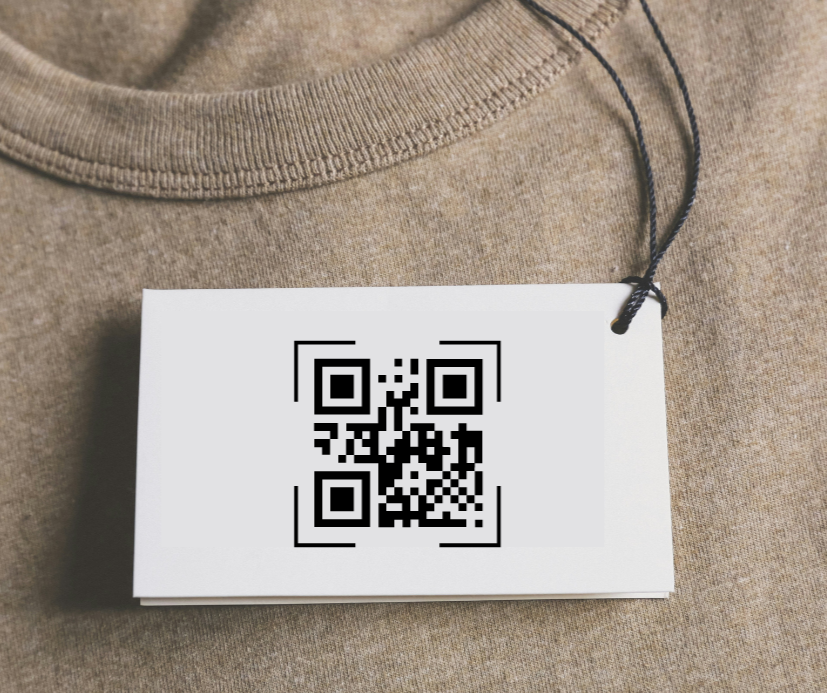
Clothing with QR codes on tags.
Image via New Look
Why the EU Is Pushing DPPs
Digital Product Passports are part of the EU’s Ecodesign for Sustainable Products Regulation (ESPR). Under this framework, most physical products sold in or imported into the European Union will eventually be required to carry a digital record.
Textiles are a priority category, meaning fashion brands selling in the EU will soon need DPP-style data just to access the market.
The European Union is taking the lead on Digital Product Passports because fashion’s environmental and social impacts extend far beyond European borders. By requiring transparency at the product level, the EU aims to influence how garments are designed, produced, and managed throughout their lifecycle. This approach shifts responsibility upstream, encouraging brands to consider sustainability early in the design phase rather than at the point of sale.
Digital Product Passports align closely with the EU’s broader Green Deal goals, which prioritize lower emissions, waste reduction, and responsible resource use. For fashion brands, this means product data is no longer optional marketing material but regulated information tied directly to market access. Companies that can quickly adapt their supply chains to provide accurate, verifiable data will gain a competitive advantage, while those that cannot may face delays, penalties, or exclusion from the EU market.
By setting clear standards, the EU is also creating pressure for global alignment. As one of the world’s largest apparel markets, EU policy has the power to reshape fashion supply chains worldwide, even influencing brands that do not primarily operate in Europe.
Why Fashion Needs Digital Product Passports
Fashion’s Supply Chains Are Long and Complex
Unlike many industries, fashion production follows a fragmented, multi-step process:
Fiber → yarn → fabric → dyeing/finishing → cut-and-sew → distribution → retail
These steps often occur across different continents, making traceability extremely difficult. Historically, brands have relied on supplier declarations, audits, or certifications — many of which are hard to verify or update in real time.
Environmental and Social Pressure Is Rising
The EU has identified textiles as one of the most environmentally damaging industries due to:
High waste volumes and low recycling rates
Microplastic pollution from synthetic fibers
Chemical-intensive processes like dyeing and finishing
Labor risks in garment-producing countries
Digital Product Passports are designed to support a shift toward circular textiles, making it easier to reuse, repair, resell, and recycle products while holding brands accountable for their claims.
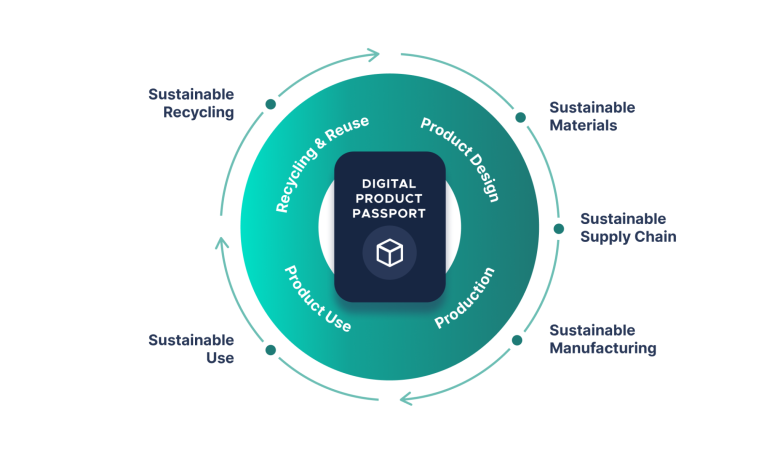
Digital Passport explained: how it is helping fashion.
Image via TexSPACE Today
How Does a Digital Product Passport Actually Work?
Every garment receives a unique digital identifier, usually embedded in a smart label. When scanned, that identifier links to a centralized data system, often cloud-based, and sometimes supported by blockchain technology for added security and immutability.
What Data Can a Fashion DPP Contain?
1. Production & Origin Data
Fiber sourcing locations
Yarn spinning mills
Fabric and dye houses
Final garment factories
2. Social & Environmental Information
Certifications (OEKO-TEX®, GRS, Fair Trade, etc.)
Carbon emissions and water usage
Chemical compliance and restrictions
3. Use Phase Information
Care and washing instructions
Repair services or spare parts
Authorized resale or rental platforms
4. End-of-Life Guidance
Recycling instructions by material type
Brand take-back programs
Sorting and disassembly tips
Unlike static care labels, Digital Product Passports are dynamic, they can be updated over time as products are repaired, resold, or recycled.
Fashion Brands Already Using DPP-Style Digital IDs
H&M Group is one of the first major mass-market brands to test Digital Product IDs at scale. The company introduced QR-based digital IDs within its Men’s Essentials collection, allowing customers to scan garments and access:
Material composition and sourcing details
Country of manufacture
Care instructions
Circular service options like resale and recycling
This initiative supports H&M’s broader circular fashion strategy while preparing the brand for upcoming EU regulatory requirements.
H&M turns to using Digital Passports.
Image by Alexandra Oakland via Canva
Digital Product Passports, Trade Policy & Global Supply Chains
Digital Product Passports are not just a sustainability tool, they are becoming a trade requirement.
Under the EU’s ESPR and related textile regulations:
Brands must supply verified product data to sell in the EU
DPPs act as proof of origin, compliance, and sustainability claims
Products without required digital documentation risk market exclusion
Implications for Trade and Customs
DPP data can be used by:
Customs authorities to verify country of origin
Regulators to check chemical and labor compliance
Brands and marketplaces to identify counterfeits

Digital Passports have become a trade requirement.
Image via World Fashion Exchange
Benefits and Opportunities of Digital Product Passports
For Brands and Suppliers
Improved traceability across Tier 1, 2, and 3 suppliers
Easier regulatory compliance with labor, chemical, and environmental rules
Stronger anti-counterfeiting protections
New revenue models, including:
Repair services
Buy-back programs
Verified resale and rental platforms
For Consumers
Clear, comparable sustainability information
Greater confidence in product authenticity
Tools to avoid greenwashing
Practical guidance on care, repair, and resale
Digital Product Passports are also reshaping how consumers interact with fashion products. Instead of guessing which brand claims are credible, shoppers can access verified product information with a single scan. This transparency empowers consumers to make choices that align with their personal values, whether that means prioritizing recycled materials, ethical labor practices, or durability.
DPPs also encourage longer product lifespans. When consumers have access to repair instructions, resale options, and recycling guidance, garments are less likely to end up as waste after limited use. Over time, this can help shift consumer behavior away from disposable fashion toward more intentional purchasing decisions. As transparency becomes the norm, brands that invest in quality and responsible production are more likely to build loyalty and long-term trust.
Digital Product Passports help rebuild trust between brands and consumers by replacing vague marketing claims with verified, accessible data.
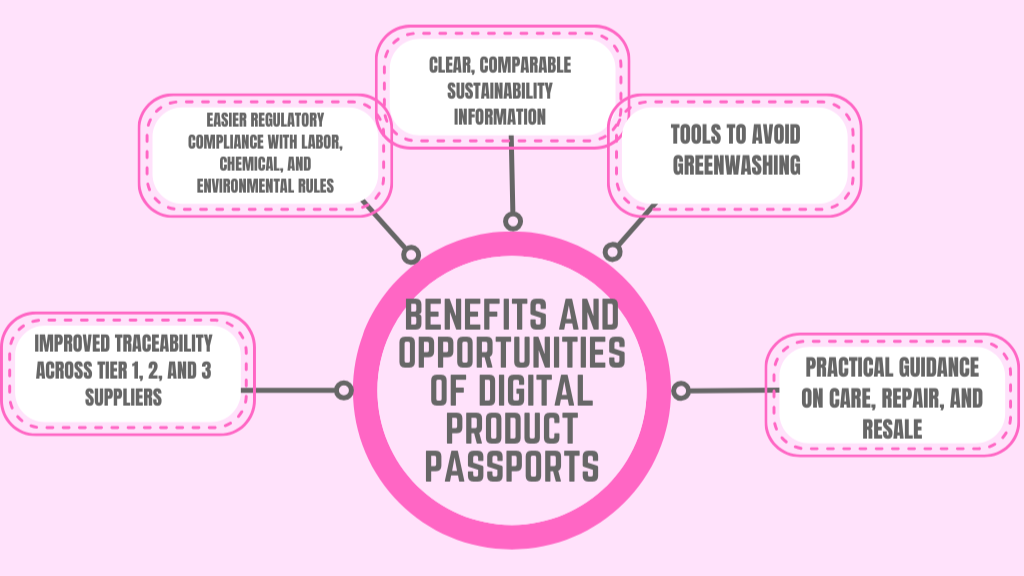
Benefits and Opportunities of Digital Product Passports.
Image by Alexandra Oakland via Canva
Challenges and Open Questions
Despite their promise, Digital Product Passports present real challenges:
Data quality & standardization: Brands must agree on what data to share and in what format
Cost & tech readiness: Smaller suppliers in countries like Bangladesh or Vietnam may struggle with infrastructure and training
Privacy & intellectual property: How much information can be shared without exposing trade secrets?
Global alignment: What happens when DPP requirements differ across regions?
These challenges highlight the need for collaboration across brands, suppliers, governments, and technology providers.
Successfully implementing Digital Product Passports will require collaboration across the entire fashion ecosystem. Brands must work closely with suppliers to build reliable data collection systems, while governments and industry groups continue developing shared standards to ensure consistency and fairness. Education and investment will be especially important for smaller suppliers, who play a critical role in global apparel production but may lack access to digital infrastructure.
Despite these challenges, Digital Product Passports represent a major step toward a more transparent and accountable fashion industry. As technology improves and standards stabilize, DPPs have the potential to become as common as care labels, quietly shaping better practices across the global supply chain.

One of the main challenges of DPP: Privacy.
Image by Alexandra Oakland via Canva
Why Digital Product Passports Matter for Fashion’s Future
Digital Product Passports are redefining how fashion products move through global markets. They turn garments into data-rich assets, making sustainability measurable, claims verifiable, and supply chains more accountable.
The shift is already underway, driven by regulation, consumer demand, and advances in fashion technology. For brands, suppliers, and students entering the industry, understanding DPPs is no longer optional.
The future of fashion belongs to brands that are ready to be transparent.
The future can bring many new changes in fashion.
Image via Vecteezy
References
European Commission. (n.d.). Ecodesign for sustainable products regulation (ESPR).
https://commission.europa.eu/energy-climate-change-environment/standards-tools-and-labels/products-labelling-rules-and-requirements/ecodesign-sustainable-products-regulation_en European Commission
European Commission. (2024, September 27). EU’s digital product passport: Advancing transparency and sustainability.
https://data.europa.eu/en/news-events/news/eus-digital-product-passport-advancing-transparency-and-sustainability Data.europa.eu
Ellen MacArthur Foundation. (n.d.). Circular economy for fashion.
https://www.ellenmacarthurfoundation.org/topics/fashion/overview Ellen MacArthur Foundation
World Trade Organization. (n.d.). Trade and environmental sustainability structured discussions (TESSD).
https://www.wto.org/english/tratop_e/tessd_e/tessd_e.htm World Trade Organization
One Click LCA. (2025). Digital Product Passport: What’s a DPP?
https://oneclicklca.com/en-us/resources/articles/digital-product-passport-whats-a-dpp One Click LCA
Backlinks
Impinj. (n.d.). Digital product passports.
https://www.impinj.com/digital-product-passports
European Commission. (n.d.). Ecodesign for sustainable products regulation (ESPR). https://commission.europa.eu/energy-climate-change-environment/standards-tools-and-labels/products-labelling-rules-and-requirements/ecodesign-sustainable-products-regulation_en
EON.xyz. (n.d.). H&M – Clients & circular economy partnership.
Hohenstein. (n.d.). OEKO-TEX®.
Image by Alexandra Oakland via Canva
